Friday, May 31, 2013

EU gives surprise breathing room to its ailing debtor states

The European Commission on Wednesday eased its deficit targets for Europe's recession-stricken states, suggesting that Brussels feels the continent's debt crisis is under control.

By Andr?s Cala,?Correspondent / May 30, 2013

European Commission President Jose Manuel Barroso gestures while speaking during a media conference at EU headquarters in Brussels on Wednesday. The European Union announced Wednesday to grant France, Spain, and four other member states more time to bring their budget deficits under control to support the bloc?s shrinking economy.

Virginia Mayo/AP

Enlarge

The European Union is giving struggling member countries a break to meet their binding deficit targets, extending deadlines while still demanding reforms, in the clearest sign yet that the crisis management is shifting from austerity to growth-driven policies.

Skip to next paragraph

' + google_ads[0].line2 + '
' + google_ads[0].line3 + '

'; } else if (google_ads.length > 1) { ad_unit += ''; } } document.getElementById("ad_unit").innerHTML += ad_unit; google_adnum += google_ads.length; return; } var google_adnum = 0; google_ad_client = "pub-6743622525202572"; google_ad_output = 'js'; google_max_num_ads = '1'; google_feedback = "on"; google_ad_type = "text"; // google_adtest = "on"; google_image_size = '230x105'; google_skip = '0'; // -->

The move has been gradual and expected, but the final report card released Wednesday by the European Commission gave countries like Spain even more breathing room than expected. France, Italy, Portugal, Poland, Slovenia, and even better off countries like the Netherlands and Belgium, also got some reprieve.

Deficit-laden countries ? especially heavyweights France, Italy, and Spain ? have long pressed northern Europeans, especially Germany, to ease off their demands for cuts. The EU faces a second straight year of recession and rising unemployment, which in countries like Spain continues to rise toward an unsustainable 30 percent.

The Organization for Economic Cooperation and Development, the international body grouping the world?s most industrialized countries, warned Wednesday that the economy of 17-member eurozone will shrink by 0.6 percent in 2013, after a similar contraction in 2012. In a report, it warned that economic weakness ?could evolve into stagnation with negative implications for the global economy.?

A turn toward stimulus?

The EU?s shift also comes after years of intense global pressure to mirror stimulus-driven policies in the US, Japan, and elsewhere, which are credited with helping turn those economies toward growth.

At the same time it suggests that EU policymakers are more confident that the deficit crisis in under control. And it illustrates growing resentment against austerity in Europe, which is blamed for the soaring unemployment and poverty in periphery countries that threatens to undermine future economic growth, despite governments? efforts to bring spending under control.

?The social emergency in many parts of Europe and the increasing level of inequalities in some regions add to the pressing need for reforms," European Commission President Jos? Manuel Barroso said.

?The fact that more than 120 million people are now at risk of poverty or social exclusion in Europe is a real worry,? Mr. Barroso said. ?We need to reform, and reform now. The cost of inaction will be very high.?

It also opens the door to more stimulus-oriented policies ? some of which, like job-creation programs, are already in the works ? and increases pressure on Europe to move more quickly toward regional fiscal consolidation in the form of a banking union, which Germany still resists.

'Breathing space'

Spain was not only given the expected two-year extension until 2016 to decrease its deficit below the ceiling of 3 percent of the gross domestic product. It was granted margin of 6.5 percent for 2013: larger than both the 6.3 percent margin that had been anticipated and the official ? and unreachable ? 4.5 percent target set in 2012. That is equal to an additional 2 billion euros, which will allow Spain to ease spending cuts this year.

France, Slovenia, and Poland were also given two additional years to meet the 3 percent target, while the Netherlands, Belgium, and Portugal were given an extra year. The Commission also took Hungary and Italy out of its list of excessive deficit procedure, which threatened countries with sanctions.

But the Commission also recommended a long list of reforms countries should undertake to spur growth. Countries can decide to implement other policies, but the targets will be binding once EU leaders rubber-stamp the EU?s report in the end of June.

?It is now of paramount importance that this breathing space created by the slower pace of consolidation is used by member states for implementing those economic reforms that are necessary to unleash our growth potential and improve our capacity to create jobs,? said Olli Rehn, EU commissioner for economic affairs.

Source: http://rss.csmonitor.com/~r/feeds/csm/~3/GR1ON24Kcts/EU-gives-surprise-breathing-room-to-its-ailing-debtor-states

mariana trench transcendental meditation trayvon martin obama care miss universe canada don draper gallagher

IK Multimedia intros AmpliTube 3.0 with timeline editing, ships iRig HD

IK Multimedia intros AmpliTube 30 with timeline editing, ships iRig HD

Artists going all-out on mobile music editing have relatively few options -- GarageBand won't always cut it for the pros. IK Multimedia thinks its newly launched AmpliTube 3.0 could be the solution for those producers on the move. The $20 iOS app introduces a full, multi-track audio editor that can create a final masterpiece. With the help of a guitar rig and customizable drum loop, the suite is theoretically good enough to keep computers out of the studio. Even if musicians don't want to go that far, they may be happy to hear that IK Multimedia has shipped the iRig HD. The $99 interface gives iOS and Mac users a preamped adapter for instruments with quarter-inch plugs. While we're sure some performers would rather stick to traditional recording methods, those who've embraced digital with open arms can check out both AmpliTube and iRig HD at the source links.

Filed under: , , ,

Comments

Source: App Store (1), (2), IK Multimedia

Source: http://feeds.engadget.com/~r/weblogsinc/engadget/~3/HjdTH6XMBRw/

Louisville football Fidelity Charlie Strong Calendar 2013 john boehner HGTV Dream Home 2013 eric cantor

Rep. Bachmann says she won't run for re-election

ST. PAUL, Minn. (AP) ? Michele Bachmann, the Minnesota congresswoman whose sharply conservative views on social and fiscal issues elevated her to a leader of the tea party movement, announced Wednesday she will not seek a fifth term but insisted the decision was unrelated to ethics inquiries or her near-loss last fall.

It was a sudden turn for the foster-mom-turned-politician. She left the door open to other, unspecified political options.

Bachmann was traveling in Russia as part of a congressional delegation and was not available for interviews. In a lengthy video message to supporters, she said her decision "was not influenced by any concerns about my being re-elected."

Ron Carey, a former chief of staff to Bachmann, said he suspects she was anticipating a tough battle ahead and seemed to be stuck in place in Congress.

"This is a great chance to exit stage right rather than have a knockdown, drag-out re-election fight," said Carey, also a former state GOP chairman. "The reality also set in that she is not a favorite of Republican leadership, so she is not going to be rising up to a committee chair or rising up in leadership."

Her departure next year is part of a larger shift involving the leading personalities of the tea party. Stalwarts like former Alaska Gov. Sarah Palin, former Rep. Allen West of Florida and former South Carolina Sen. Jim DeMint have left elected office to move into conservative organizations and commentary roles.

They've been replaced by a new round of tea party-backed lawmakers such as Sens. Ted Cruz of Texas and Mike Lee of Utah and Rep. Raul Labrador of Idaho.

"The movement had moved past her to a new round of leaders in Congress and the states around the country," said Dick Wadhams, a Colorado-based Republican strategist. "In a short period of time, a new generation has stepped forward since the last election."

Bachmann also said her decision "was not impacted in any way by the recent inquiries into the activities of my former presidential campaign" last year. In January, a former Bachmann aide filed a complaint with the Federal Election Commission, claiming the candidate made improper payments to an Iowa state senator who was the state chairman of her 2012 presidential run. The aide, Peter Waldron, also accused Bachmann of other FEC violations.

Bachmann had given few clues she was considering leaving Congress. Her fundraising operation was churning out regular pitches for the small-dollar donations that she collected so well over the years. She also had an ad running on Twin Cities television promoting her role in opposing President Barack Obama's health care overhaul. The early timing of the ad suggested she was preparing for a tough fight against Democrat Jim Graves, a hotel chain owner who narrowly lost to Bachmann in November.

Without the polarizing Bachmann on the ticket, Republicans could have an easier time holding a district that leans more heavily in the GOP direction than any other in Minnesota. A parade of hopefuls was expected.

By Wednesday morning, state Rep. Matt Dean, a former House majority leader, said he was inclined to run.

"It is something I have thought about in the past if Michele were to not run again," Dean said. "It's not something that I just started thinking about this morning."

Graves said he thought Bachmann had "read the tea leaves."

"The district is changing," the Democrat said in an interview Wednesday with Minneapolis television station KARE. "They want somebody who really does have some business background and understands the economy and can get things done in Washington and back in the district."

Andy Aplikowski, who has long been active in the district's Republican Party chapter, said he expected Bachmann to run again but can understand why she didn't.

"It's a grueling thing to be in Congress. It's a grueling thing to be Michele Bachmann in Congress," he said. "Every move you make is criticized and put under a microscope."

Bachmann's strongly conservative views propelled her into politics, and once there, she never backed down.

She was a suburban mother of five in 1999 when she ran for a Minnesota school board seat because she thought state standards were designed to teach students values and beliefs.

She lost that race, but won a state Senate seat a year later. Once in St. Paul, she seized on gay marriage as an issue and led a charge to legally define marriage in Minnesota as between one man and one woman. That failed, but Bachmann had laid the foundation with social conservatives to help propel her into Congress in 2006.

In Washington, she turned to fiscal issues, attacking Democrats and President Barack Obama for government bailouts and the health care overhaul. Even in her early years in Congress, Bachmann frequently took those views to right-leaning cable talk programs, cultivating her national image as she built a formidable fundraising base with like-minded viewers outside Minnesota.

But her penchant for provocative rhetoric sometimes backfired. She was hammered in 2008 for saying Obama might have "anti-American views," a statement that prompted a rare retreat by Bachmann and made her race that year closer than it would have been. She was also criticized by her fellow Republicans last July for making unsubstantiated allegations that an aide to Secretary of State Hillary Rodham Clinton had family ties to Egypt's Muslim Brotherhood.

Her White House bid got off to a promising start, with a win in an Iowa GOP test vote. But Bachmann quickly faded and finished last when the real voting started in Iowa's leadoff caucuses, a result that caused her to drop out. Saddled with debt, she opted to campaign again for her Minnesota seat and squeaked through.

But the failed presidential campaign continued to dog her. Allegations of improper payments prompted ethics inquiries. Bachmann also faced a lawsuit from a former aide that alleged someone on the congresswoman's team stole a private email list of home-school supporters for use in the campaign. That case is pending.

On Wednesday, Bachmann promised supporters she would "continue to work overtime for the next 18 months in Congress defending the same Constitutional Conservative values we have worked so hard on together."

As for her plans beyond Congress, she said, "There is no future option or opportunity, be it directly in the political arena or otherwise, that I won't be giving serious consideration if it can help save and protect our great nation."

Bachmann's success in the talk media world led industry analysts to say she could easily move into a gig as a host. She has been mentioned as a potential challenger to first-term Democratic Sen. Al Franken but has given little indication that she would take that step.

___

Thomas reported from Washington. Associated Press writer Lou Kesten contributed.

Source: http://news.yahoo.com/rep-bachmann-says-she-wont-run-election-083343871.html

Prince Harry Vegas pictures Avril Lavigne Microsoft Tropical Storm Isaac amber portwood Phyllis Diller Darla Moore

America Has Lost the Will to Swim for Its Life, Apparently, Because Obama

A terrible thing happened last week: a bridge collapsed in Washington state, leaving three people stranded in the middle of a river, waiting to be rescued by boat. According to conservative commentator Tony Katz, the terrible thing was not the nation's frail infrastructure. It was that those three wimps were too scared to swim to shore. Katz said on an NRA Internet radio show last week:

Katz: Well one of the guys tells a story about how his shoulder separated, like his shoulder popped out. And his wife was next to him. He popped his own shoulder into place and then got his wife to get out. Now that's a guy fully actualized and knowing that he has to live.

Where this thing dropped seemed to me not to be very far, I mean easy get over to the banks where you can get onto dry land. Some of them waited on their cars for an hour for help to arrive?

What has happened in our entire evolution of the past 30 years that we've gone from guys who were standing on the street jumping into ice water to save a woman and here we have people who are 25 feet from shore, if they weren't injured, couldn't make that swim, or ten people couldn't create a human chain. Or it took an hour to get some kind of boat.

RELATED: Conservatives Control the Political E-mail Rumor Mill

That's right, 30 years of liberalism has turned Americans into water-fearing fraidy cats. Katz cited conservative commenter Dennis Miller's claim that during Hurricane Katrina, stranded people were "up to their knees in water screaming out, where is the government to help me?" That was what's at heart in the liberal fight for gun control ? to get people wimpier, to think "you can't do it, only government can," Katz said. "It gets us nowhere, it gets us dead."

RELATED: Troubled Bridge Over Washington Water Collapses into 'Big Puff of Dust'

Those grand unifying theories of everything always get people into trouble. Katz's theory is just an extension of the old saw that liberals coddle criminals, single moms, and people on welfare. Surely people who fear drowning must fit in there somewhere! As?Media Matters' Timothy Johnson points out, the water of the Skagit River?was 46 degrees and 18 feet deep. Rescuers took so long because they had to?maneuver?"tangled bridge wreckage," KTVZ reported.?So those people didn't swim because they were wimps, they didn't swim because they didn't have a death wish.

RELATED: Bridges and U.S. Infrastructure Spending Are Falling: Is There a Link?

(Photo via Associated Press.)

Source: http://news.yahoo.com/america-lost-swim-life-apparently-because-obama-211249952.html

Watertown Boston npr Oblivion Hemlock Grove Boston Bomber Death Photo Fox Boston Bomber

Thursday, May 30, 2013

Study finds that radiation oncology research is critically underfunded by NIH

Study finds that radiation oncology research is critically underfunded by NIH [ Back to EurekAlert! ] Public release date: 29-May-2013
[ | E-mail | Share Share ]

Contact: Michelle Kirkwood
michellek@astro.org
703-286-1600
American Society for Radiation Oncology

Radiation oncology received only 1.6 percent of total NIH FY 2013 funding for cancer research

Radiation oncology research received 197 grants, totaling only 1.6 percent ($85.5 million) of the $5.4 billion in cancer research funding from the National Institutes of Health (NIH) in Fiscal Year (FY) 2013, according to a study available online and in the June 1, 2013, print issue of the International Journal of Radiation Oncology Biology Physics (Red Journal), the official scientific journal of the American Society for Radiation Oncology (ASTRO).

The study reviewed the more than 50,000 grants funded by the NIH, totaling $30.9 billion. Investigation revealed 952 active individual grants in the fields of diagnostic radiology and radiation oncology at the start of FY 2013; the NIH database does not discriminate between the two departments. Additionally, study authors conducted a manual identification process of proposals from radiation oncology departments, yielding 197 grants in radiation oncology. Of the 197 grants in radiation oncology, 79.2 percent (156) were in the field of radiation oncology biology; 13.2 percent (26) were in the field of medical physics as it relates to radiation oncology; and only 7.6 percent (15) were clinical investigations of radiation oncology treatment. Forty-three academic institutions were represented in the total 197 studies, with 141 grants in year 1?5 of their funding cycle, and 56 awards in funding year 6?25.

The Accreditation Council for Graduate Medical Education lists 87 academic programs in radiation oncology in the U.S., yet only 49.4 percent have an active research program supported by NIH grants. Academic radiation oncology departments attract the highest percentage of MD/PhD graduates into its residency programs, representing the top tier of medical school graduates. Data from the 2011 National Resident Matching Program report indicates that there are 75 academic radiation oncology programs in the United States for only 155 radiation oncology physician residency positions.

This study also provides detailed analysis of the average award size, the professional degree status of the grantees, and which grant funding mechanism within the NIH (RO1, U19, PO1, R21, KO1 and U24) received the most applications and grants awarded.

"Nearly two-thirds of cancer patients receive radiation therapy as part of their cancer treatment protocol, yet only 1.6 percent of cancer research funding is in the field of radiation oncology. We have a significant disparity in the current level of research support as compared to the relevance of radiation oncology for cancer patients and its highly skilled work force," said lead study author Michael L. Steinberg, MD, FASTRO, chair of the department of radiation oncology at the David Geffen School of Medicine at the University of California, Los Angeles (UCLA), and the Jonsson Comprehensive Cancer Center at UCLA. "Our study indicates an urgent need to separate radiation oncology data from radiology in the NIH database. It is also essential that radiation oncology receive more substantial funding support so that we, as an integral specialty in cancer care, can continue to improve patient survival and treatment outcomes."

"In the U.S., nearly one million cancer patients are treated each year with lifesaving radiation therapy," said Colleen A. F. Lawton, MD, FASTRO, president of ASTRO and professor, program director and vice-chairman of radiation oncology at the Medical College of Wisconsin in Milwaukee. "We must secure increased research funding to ensure advancement in radiation oncology techniques and protocols."

In addition to Steinberg, study authors include William H. McBride, PhD, DSc, Erina Vlashi, PhD, and Frank Pajonk, MD, PhD, in the department of radiation oncology at the David Geffen School of Medicine at UCLA and the Jonsson Comprehensive Cancer Center at UCLA.

In an editorial, also published in the June 1, 2013 issue of the Red Journal, Reshma Jagsi, MD, DPhil, and Lynn D. Wilson, MD, MPH, FASTRO, detail several priority areas for research in radiation oncology and raise concern for the long-term negative effects of insufficient research funding on patients and professionals. "The data Steinberg and colleagues were able to collect suggests that a critically important field is receiving a surprisingly tiny sliver of the too-small pie of biomedical research funding." Drs. Jagsi and Wilson conclude, "This pattern is likely to be self-reinforcingto the peril of patients and society in generaland it merits both attention and action."

Jagsi and Wilson note that several priority areas for research have been identified in a study conducted by the Radiation Oncology Institute, including quality and safety of radiation delivery, communication, survivorship and toxicity management, comparative effectiveness and value of radiation therapy, including comparison of outcomes after radiation with outcomes after other treatments and among different forms of radiation treatment.

Dr. Jagsi is an associate professor in the department of radiation oncology and Center for Bioethics and Social Sciences in Medicine at the University of Michigan in Ann Arbor, Mich., and Dr. Wilson is professor and vice chairman of the department of therapeutic radiology at Yale University School of Medicine in New Haven, Conn.

###

For the complete text of the study, contact Michelle Kirkwood, 703-286-1600, press@astro.org. To learn more about the Red Journal, visit http://www.redjournal.org.

ABOUT ASTRO

ASTRO is the premier radiation oncology society in the world, with more than 10,000 members who are physicians, nurses, biologist, physicists, radiation therapists, dosimetrists and other health care professionals that specialize in treating patients with radiation therapies. As the leading organization in radiation oncology, the Society is dedicated to improving patient care through professional education and training, support for clinical practice and health policy standards, advancement of science and research, and advocacy. ASTRO publishes two medical journals, International Journal of Radiation Oncology Biology Physics and Practical Radiation Oncology; developed and maintains an extensive patient website, http://www.rtanswers.org; and created the Radiation Oncology Institute, a non-profit foundation to support research and education efforts around the world that enhance and confirm the critical role of radiation therapy in improving cancer treatment. To learn more about ASTRO, visit http://www.astro.org.


[ Back to EurekAlert! ] [ | E-mail | Share Share ]

?


AAAS and EurekAlert! are not responsible for the accuracy of news releases posted to EurekAlert! by contributing institutions or for the use of any information through the EurekAlert! system.


Study finds that radiation oncology research is critically underfunded by NIH [ Back to EurekAlert! ] Public release date: 29-May-2013
[ | E-mail | Share Share ]

Contact: Michelle Kirkwood
michellek@astro.org
703-286-1600
American Society for Radiation Oncology

Radiation oncology received only 1.6 percent of total NIH FY 2013 funding for cancer research

Radiation oncology research received 197 grants, totaling only 1.6 percent ($85.5 million) of the $5.4 billion in cancer research funding from the National Institutes of Health (NIH) in Fiscal Year (FY) 2013, according to a study available online and in the June 1, 2013, print issue of the International Journal of Radiation Oncology Biology Physics (Red Journal), the official scientific journal of the American Society for Radiation Oncology (ASTRO).

The study reviewed the more than 50,000 grants funded by the NIH, totaling $30.9 billion. Investigation revealed 952 active individual grants in the fields of diagnostic radiology and radiation oncology at the start of FY 2013; the NIH database does not discriminate between the two departments. Additionally, study authors conducted a manual identification process of proposals from radiation oncology departments, yielding 197 grants in radiation oncology. Of the 197 grants in radiation oncology, 79.2 percent (156) were in the field of radiation oncology biology; 13.2 percent (26) were in the field of medical physics as it relates to radiation oncology; and only 7.6 percent (15) were clinical investigations of radiation oncology treatment. Forty-three academic institutions were represented in the total 197 studies, with 141 grants in year 1?5 of their funding cycle, and 56 awards in funding year 6?25.

The Accreditation Council for Graduate Medical Education lists 87 academic programs in radiation oncology in the U.S., yet only 49.4 percent have an active research program supported by NIH grants. Academic radiation oncology departments attract the highest percentage of MD/PhD graduates into its residency programs, representing the top tier of medical school graduates. Data from the 2011 National Resident Matching Program report indicates that there are 75 academic radiation oncology programs in the United States for only 155 radiation oncology physician residency positions.

This study also provides detailed analysis of the average award size, the professional degree status of the grantees, and which grant funding mechanism within the NIH (RO1, U19, PO1, R21, KO1 and U24) received the most applications and grants awarded.

"Nearly two-thirds of cancer patients receive radiation therapy as part of their cancer treatment protocol, yet only 1.6 percent of cancer research funding is in the field of radiation oncology. We have a significant disparity in the current level of research support as compared to the relevance of radiation oncology for cancer patients and its highly skilled work force," said lead study author Michael L. Steinberg, MD, FASTRO, chair of the department of radiation oncology at the David Geffen School of Medicine at the University of California, Los Angeles (UCLA), and the Jonsson Comprehensive Cancer Center at UCLA. "Our study indicates an urgent need to separate radiation oncology data from radiology in the NIH database. It is also essential that radiation oncology receive more substantial funding support so that we, as an integral specialty in cancer care, can continue to improve patient survival and treatment outcomes."

"In the U.S., nearly one million cancer patients are treated each year with lifesaving radiation therapy," said Colleen A. F. Lawton, MD, FASTRO, president of ASTRO and professor, program director and vice-chairman of radiation oncology at the Medical College of Wisconsin in Milwaukee. "We must secure increased research funding to ensure advancement in radiation oncology techniques and protocols."

In addition to Steinberg, study authors include William H. McBride, PhD, DSc, Erina Vlashi, PhD, and Frank Pajonk, MD, PhD, in the department of radiation oncology at the David Geffen School of Medicine at UCLA and the Jonsson Comprehensive Cancer Center at UCLA.

In an editorial, also published in the June 1, 2013 issue of the Red Journal, Reshma Jagsi, MD, DPhil, and Lynn D. Wilson, MD, MPH, FASTRO, detail several priority areas for research in radiation oncology and raise concern for the long-term negative effects of insufficient research funding on patients and professionals. "The data Steinberg and colleagues were able to collect suggests that a critically important field is receiving a surprisingly tiny sliver of the too-small pie of biomedical research funding." Drs. Jagsi and Wilson conclude, "This pattern is likely to be self-reinforcingto the peril of patients and society in generaland it merits both attention and action."

Jagsi and Wilson note that several priority areas for research have been identified in a study conducted by the Radiation Oncology Institute, including quality and safety of radiation delivery, communication, survivorship and toxicity management, comparative effectiveness and value of radiation therapy, including comparison of outcomes after radiation with outcomes after other treatments and among different forms of radiation treatment.

Dr. Jagsi is an associate professor in the department of radiation oncology and Center for Bioethics and Social Sciences in Medicine at the University of Michigan in Ann Arbor, Mich., and Dr. Wilson is professor and vice chairman of the department of therapeutic radiology at Yale University School of Medicine in New Haven, Conn.

###

For the complete text of the study, contact Michelle Kirkwood, 703-286-1600, press@astro.org. To learn more about the Red Journal, visit http://www.redjournal.org.

ABOUT ASTRO

ASTRO is the premier radiation oncology society in the world, with more than 10,000 members who are physicians, nurses, biologist, physicists, radiation therapists, dosimetrists and other health care professionals that specialize in treating patients with radiation therapies. As the leading organization in radiation oncology, the Society is dedicated to improving patient care through professional education and training, support for clinical practice and health policy standards, advancement of science and research, and advocacy. ASTRO publishes two medical journals, International Journal of Radiation Oncology Biology Physics and Practical Radiation Oncology; developed and maintains an extensive patient website, http://www.rtanswers.org; and created the Radiation Oncology Institute, a non-profit foundation to support research and education efforts around the world that enhance and confirm the critical role of radiation therapy in improving cancer treatment. To learn more about ASTRO, visit http://www.astro.org.


[ Back to EurekAlert! ] [ | E-mail | Share Share ]

?


AAAS and EurekAlert! are not responsible for the accuracy of news releases posted to EurekAlert! by contributing institutions or for the use of any information through the EurekAlert! system.


Source: http://www.eurekalert.org/pub_releases/2013-05/asfr-sft052913.php

Christoph Waltz Quvenzhané Wallis dancing with the stars cast kristen stewart Shirley Bassey adele Oscars 2013

Nanomedicines' impact on patients under the microscope

May 29, 2013 ? A pioneering imaging technique to track the effects of next-generation nanomedicines on patients has been harnessed by a University of Strathclyde academic.

Professor Dr M. N. V. Ravi Kumar and Dr Dimitrios Lamprou, of the Strathclyde Institute of Pharmacy and Biomedical Sciences, believe an advanced form of atomic force microscopy, known as PeakForce QNM, could boost developments in the field of nanomedicines, the encapsulation of potent drugs in tiny particles measuring billionths of a meter in diameter. They described how this detailed imaging approach may also help scientists address growing concerns in the medical world around "nanotoxicology," the build-up of microscopic particles in people's tissues.

Professor Kumar, whose team's research article has been published in the journal PLOS ONE, said: "Nanotechnology's role in drug delivery has the power to transform the way patients are given medicines over the next decade or so.

"In the case of traditional medicines, such as tablets and capsules, only a limited amount of drug -- thought to be around five to 15 per cent for the majority of compounds -- makes it through the gut into patients' blood. The good thing about nanomedicines is that -- unlike as is the case with traditional tablets and capsules -- the drugs are not released in the gut. Instead, nanomedicines are absorbed intact and release the encapsulated drugs directly into bodily tissues, including the blood, offering the possibility to reduce the required dose without compromising the therapeutic effects.

"All medicines are combined with what are known as 'excipients' -- inactive substances which give them the desired bulk and consistency and their role is restricted to the gut. However, the excipients such as polymers, used to formulate the nanoparticle-encapsulating drugs may exhibit undesired effects when they are absorbed through the gut wall. Scientists want to know if nanoparticle-based drugs can have any adverse effects on patients -- and, in particular, if they cause more harm than good in some cases.

"Up until now, little has been known about what happens after nanoparticles circulate throughout the body and if they raise any safety issues for the patient. Previously, it was necessary for nanoparticles to be given a fluorescent or radioactive label, in order to allow scientists to be able to identify and track them. However, by using PeakForce QNM atomic force microscopy we can, for the first time, track where these nanoparticles are going throughout the body after oral administration -- without attaching any fluorescent or radioactive labels and by using the real drug loaded nanoparticles. In particular, we can identify if they are accumulating in specific areas, causing what is known as 'tissue stiffness' -- a condition linked to a variety of diseases, including cancer."

Professor Kumar said it is known that tumours are more rigid -- or stiff -- when compared with surrounding healthy tissues. In addition, recent studies using atomic force microscopy have also shown it is possible to distinguish between non-malignant and malignant tumours cells, on the basis of their relative stiffness.

Professor Kumar added: "The ability of atomic force microscopy to study biomechanical profiles will be an asset in efforts to better understand the difference in tissue stiffness between tissues treated with nanoparticles and those not treated with nanoparticles, how long any associated tissue stiffness persists, and if it disappears quickly. Importantly, it will also help to establish whether or not there is a correlation between the number of nanoparticles present in blood and their accumulation in other tissues. By understanding more about blood stiffness, we will be able to learn more about nanotoxicology generally, and how that affects patients.

"By using atomic force microscopy in this way, we may in future be able to analyse patients' blood and tell if, for example, nanomaterials are accumulating in their livers or arterial walls, causing stiffness which -- if it persists long enough -- may increase their chances of developing diseases.

"Another benefit of nanoparticles is that -- if used at an early stage of the research -- they could save pharmaceutical firms money by reducing the number of drugs that fail at the development stage. These cost savings could then be reinvested into the research and development of new drugs to treat patients."

Source: http://feeds.sciencedaily.com/~r/sciencedaily/top_news/~3/dSOa2WEv_Jw/130529101517.htm

pauly d project adrienne rich autism cesar chavez day raspberry ketone ron burgundy millennial media

Zimbabwe minister says economy shrinking on vote uncertainty

By MacDonald Dzirutwe

HARARE (Reuters) - Uncertainty over the date of elections in Zimbabwe is pushing the fragile economy closer to recession just as it was pulling out of a decade of decline, the finance minister said on Tuesday.

Presidential and parliamentary elections should be held this year but political reforms and problems finding the money to pay for the vote in the impoverished country are holding things up and no date has been set.

Finance Minister Tendai Biti said the economy could have shrunk by up to 3 percent during the first quarter of this year due to election uncertainty as well as low farm output, declining tax revenues and export earnings.

"The elephant in the living room evidently is the election and the sooner there is clarity on the dates from the politicians the better for the economy," Biti told reporters.

Zimbabwe needs $132 million to fund the election but conditions attached to any foreign financing have divided the already fractious unity government, whose main players - President Robert Mugabe's ZANU-PF and Prime Minister Morgan Tsvangirai's MDC - will be rivals for power in the vote.

Any repeat of violence that accompanied the last vote in 2008 could end Zimbabwe's nascent economic recovery and unleash another refugee crisis similar to the one five years ago when hundreds of thousands fled to neighbouring South Africa.

The state-owned Herald newspaper quoted Mugabe as saying regional leaders would hold a summit to discuss how to fund the election in which the president is seeking to extend his three-decade rule

Officials from the SADC regional bloc of 15 southern African states were not immediately available for comment.

ZANU-PF is pushing for funding with as few strings as possible. It withdrew a United Nations request to fund the poll accusing the U.N. of trying to interfere in domestic issues.

The MDC is keen to attach the money to the deployment of election observers. It fears ZANU-PF, whose members are under Western sanctions for suspected rigging of previous votes, will use the security forces to intimidate voters.

But SADC observers could be a compromise amenable to Mugabe, who regularly rails against the West for imposing sanctions he blames for ruining an economy that critics say was wrecked by his own policies.

ZANU-PF wants elections by June 29, when parliament will be dissolved, but the MDC says they should be delayed to allow for the opening of broadcast media - currently a state monopoly - to private players, registration of new voters and reform of the military to keep it out of politics.

Mugabe and Tsvangirai displayed rare unity this year in pushing through a new constitution at a referendum, a critical step for the election but which depleted state coffers for the next vote.

The new constitution clips the powers of the president and imposes a two-term limit. It does not apply retroactively so the 89-year-old Mugabe could, in theory, rule until he is 99.

Source: http://news.yahoo.com/zimbabwe-minister-says-economy-shrinking-vote-uncertainty-162732286.html

dalai lama tamera mowry slow jam the news madden cover obama slow jams the news metta world peace ron artest

Tuesday, May 28, 2013

In all the excitement over a stock Android Galaxy S4, have you ever stopped to t...

Sorry, Readability was unable to parse this page for content.

Source: http://www.facebook.com/photo.php?fbid=10151682124189680&set=a.10150436470349680.422815.103687894679&type=1

mary kay ash tiny houses maya angelou joan of arc tony robbins bon iver abraham lincoln vampire hunter

Fire breaks out aboard Royal Caribbean cruise ship

BALTIMORE (AP) ? Royal Caribbean says a fire that broke out aboard a ship has forced it to cancel the rest of the cruise and that more than 2,000 passengers will be flown back to Baltimore from the Bahamas.

The cruise line says the fire that began at 2:50 a.m. Monday was extinguished about two hours later with no injuries reported. A cause wasn't immediately known.

Royal Caribbean said in a series of tweets later Monday that executives have met with passengers aboard the ship and that the cruise line is arranging flights for all guests on Tuesday.

It said passengers will receive a full refund of their fare and a certificate for a future cruise.

Source: http://news.yahoo.com/fire-breaks-aboard-royal-caribbean-cruise-ship-121209870.html

roses april fools Good April Fools Jokes Dumpster Diaper the beach Fear

Foxconn and Mozilla join hands over Firefox OS, may show off new devices next week

In a Chinese invitation we received earlier today, Foxconn Technology Group and Mozilla confirmed an upcoming press conference that will detail and make their Firefox OS partnership official. The event will take place in Taipei next Monday (just a few days before Computex truly kicks off), and it'll see Mozilla welcome the 19th partner to its Firefox OS alliance. There isn't much meat in the email, though we did spot a little hint in the rundown that says one or more "latest" Firefox OS products will be displayed. Whatever they may be, we shall keep an eye out for them as soon as we land in Terry Gou's back garden next week.

Filed under: ,

Comments

Via: Focus Taiwan

Source: http://www.engadget.com/2013/05/27/foxconn-mozilla-firefox-os-partnership/?utm_medium=feed&utm_source=Feed_Classic&utm_campaign=Engadget

Ryan Lochte Bayern Munich the blaze Michael Shannon Chrissy Amphlett Java stevie wonder

Niche travel is TTM's signature : TTR Weekly

BANGKOK, 27 May 2013: Tourism Authority of Thailand says it will strengthen Thailand?s tourism by highlighting four niche markets ? ecotourism, golf, weddings and honeymoons, and health and wellness at the 12th Thailand Travel Mart Plus Amazing Gateway to the Greater Mekong Sub-region.

TTM Plus will be held 5 to 7 June, at Bangkok?s IMPACT Muang Thong Thani Exhibition Centre.

Priority has been given to sellers from four niche markets as the objective is to showcase Thailand as a market leader in these specialised segments through the theme ?Customise your Experience?.

TTM majors on Thailand?s travel products, but links them to neighbouring destinations hence the official name Thailand Travel Mart plus Amazing Gateway to the Greater Mekong Sub-region.

TAT governor, Suraphon Svetasreni, said: ?The authority?s ?priority remains unchanged. We will promote niche-market tourism as we move into a new era of marketing and development. This year, it will be more evident than ever as the entire structure of TTM+ is geared towards this strategy and connecting the right buyer to the right seller.?

Ecotourism

The ecotourism niche has its roots in a long-term commitment in the country?s travel and tourism industry to be more conscious of its environmental responsibilities. TAT has for years been undertaking environmental production activities and projects such as the Green Leaf Certification Programme, and the 7 Greens Concept, with an aim to promote environmentally-friendly tourism.

Diversity in Thailand?s eco-tourism products linked to its natural resources is a vital asset of the country, but it is still important for the travel industry to develop more environmentally friendly destinations.

Ecotourism activities focus on the following areas:

? Cycling

Specialised travel agencies offer cycling tours mainly half-day trips near Bangkok in places such as Nonthaburi?s Kred Island, Ayutthaya, or Samut Songkram?s Amphawa. Tours reduce the use of vehicles and offer participants an opportunity to touch base with rural communities on the outskirts of Bangkok. There are also more serious multi-day biking holidays that focus long distance cycle trips throughout the country with links to neighhbouring countries.

? Bird watching

Thailand is a habitat for both migratory and residential bird species. There are hundreds of different types of migratory birds from northern and western Asia. Birds are abundant in Thailand with more than 990 species having been identified.

The majority of birds are found in forested national parks, or sanctuaries such as Khao Yai National Park (Nakhon Ratchasima, Saraburi, Prachinburi and Nakhon Nayok), Phetchaburi?s Kaeng Krachan National Park, and Chaiyaphum?s Phu Kheao Wildlife Sanctuary. But bird watching trips can be organised practically anywhere with interesting species spotted close to Bangkok including elegant fish catching storks just 30 km north of the capital.

? Community-based tourism

Based on the principle that individual cultures and environments are worth conserving, this kind of tourism attempts to put visitors in touch with local traditions, values and communities so they can see for themselves the different lifestyles. Travellers can stay overnight in a village, join rural people in their daily life of planting and harvesting crops, or fishing in rivers. Or perhaps even joining fishing trips on the Gulf of Thailand. At the same time, the hosts can learn about visitors? country, traditions, occupations and lifestyles.

? River cruising

It represents a convenient transport mode for visitors to glimpse the way of life of traditional Thai people and to see historical sites which stand close to river banks.

There are many ways for visitors to explore the various rivers that are important trading channels running through the heart of the country. Tour boats particularly converted traditional wooden rice barges, offer dinner cruises along the Chao Phraya River as well as longer trips upriver from Bangkok to Ayutthaya.

? Kayaking/ canoeing

This activity provides the benefit of building a healthy lifestyle and a mode of travel that is friendly to the environment causing minimal damage to marine ecosystems.

Some of ?the most spectacular sites for sea kayaking/canoeing are in South Thailand and include Phang Nag?s Phang Nga bay, Surat Thani?s ?Khao Sok and Satun?s Tarutao National Park.

? Rock climbing/abseiling

It is a relatively new sport in Thailand and is considered an adventure with hundreds of choices such as abseiling on 70- metre high cliffs, team building, rope climbing, rock-climbing on specially designed walls or real-time cliff climbing around Thailand.

Where to climb: Pa Ngam Adventure Town and Mountain Lodge Nadi in Prachinburi; Greenery Khao Yai Resort and Suansri Kanok Porn Resort in Nakhon Ratchasima; Fair Tex Sport Club in Pattaya; and Railey in Krabi.

Weddings and Honeymoons

Weddings and honeymoons are now a top revenue earner for Thailand?s specialised travel agencies and hotels prepared to go the extra mile to offer service.

According to TAT governor Suraphon Svetasreni, one of the TAT?s key marketing strategies is to position Thailand as a top weddings and honeymoons destination. The highest success rates in this market segment have been recorded in India, China, Korea, Japan, France, United States and the United Arab Emirates.

The United States and European markets are strong in honeymoon markets for several destinations across Thailand and this is mainly due to TAT pushing more packages and campaigns via channels like social media and websites such as?www.honeymooning-in-thailand.com.

With the value of more than US$20 billion, the Indian wedding market alone is growing at 20% to 30% annually and an important source of business for Thailand.

Thailand is attractive to Indians because the country offers exactly what Indian couples are looking for such as value-for-money and a strong appeal as a desirable venue for a celebrity style wedding.

Thailand is around 30% to 50% cheaper than sites in India. It also has similar beliefs and traditions making it easier to organise ceremonies.

Other strong points include a hospitality culture, highly skilled staff in area such as flower arrangement or ice carvings. Short travelling times of around 2.5 to 3.5 hours from major airports in India to Bangkok or Phuket is another key factor.

Indians are also compulsive shoppers so once they are in Thailand they will use the occasion to go shopping on the sidelines of the ceremonies and banquets.

China is another important market for weddings. TAT considers the Chinese market as a high potential market in terms of volume. Also Chinese travellers stay on average 7.95 days and spend ?Bt4,862.24 per day, per person. There are over 150 scheduled flights from China to Thailand a week.

TAT has highlighted seven destinations that are suitable for weddings and honeymoons: Bangkok, Chiang Mai, Chiang Rai, Krabi, Phuket, Hua Hin and Pranburi in Prachuap Khirikhan and Samui Island in Surat Thani province.

There are several adventure themes that can be used to make a wedding unusual such as rock climbing ? exchanging vows while dangling from a cliff at Rai Le Beach in Krabi province or an underwater wedding ceremony held annually in Trang province.

Those who prefer a traditional wedding should head north to experience a Lanna-style wedding on elephant back or sit in a horse-drawn carriage in Lampang provincei.

Golf

Golf is already a major player in Thailand?s sports tourism business, but the Tourism Authority of Thailand?s vision is to grow this lucrative sports niche to new heights.

Golfers will make a beeline for five major golf destinations; Bangkok, Phuket, Hua Hin, Pattaya and Chiang Mai.

Golf tourists spend an average of Bt100,000 excluding flights ? three times the average of other tourists. They spend most of it on their sport ?honing their game ?skills and even shopping for the latest gear.

The surge in golf tourism to Thailand will ultimately make the country Asia?s

most popular destination for foreign golfers based on one simple fact ? its quality courses that still have room to accommodate visitors. It means serious golfers can during the weekdays go round a popular course in four hours flat.

Thailand is already catching up on the world leader in golf tourism, Spain, which attracts almost a million visits a year.

Other top golf destinations are Scotland, Ireland and the United States all leading the pack, but Thailand can catch up even though air travel time for players is much longer from the big source markets.

Once on the greens, the cost of playing is lower, but probably the key factor is Thailand?s relatively crowd-free courses, all 260 of them, just 60 fewer than Spain, 200 fewer than Scotland and 100 less than Ireland.

Australian golfers represent 10% to 15% of the market mix that is still led by Europe at 65%, but a stronger Aussie dollar is helping to build demand.

But it is just a matter of time for Japanese, Taiwanese, Korean and Chinese golfers to take the poll position. Europeans favour golf visits during the November to March winter, while Asian golfers travel year-round.

Most of the 260 golf courses are up to scratch to host tournaments, including internationally renowned Honda LPGA and the Royal Trophy ? Europe vs. Asia Golf Championship.

Golfers recognise the course designs of former top rated golfers Jack Nicklaus, Nick Faldo, Greg Norman, Pete Dye and Robert Trent Jones Jr.

Golf is a year-round sport in Thailand, but is really enjoyable in the cool and dry months of November to February.

The summer season, from March to late May, is not ideal, but avid golfers just set the alarm clock one hour earlier and do nine holes before the ?sun starts to take its toll on performance.

During the rainy season, from July to October, downpour can be severe, but they rarely hold up a game for more than an hour.

In Bangkok, there are several courses around the city and its suburbs, mostly within an hour?s driving time. Some of these are rated top courses that have hosted international tournaments.

Pattaya, Hua Hin, Phuket and Samui all have excellent coastal courses. If golfer prefers natural courses that follow a hilly terrain then they head for northern destinations Chiang Mai and Chiang Rai. There are excellent courses in the Northeast starting in Nakhon Ratchasima and in Kanchanaburi near the River Kwai to the west of the country.

Health & Wellness

People are living longer due to improved health and medical treatments. They are more concerned about climate and a boom in information technology means faster pick up of ideas and the ability to source travel ideas that will improve lifestyle.

Medical tourism is just one part of the wellness industry that extends to spas, heath farms and lifestyle and diet regimes all designed to improve quality of life. It earned around US$35 billion in 2009 and should increase to US$58 billion in 2012, a growth rate of 20% yearly.

Thailand is a top player in medical tourism, especially in Asia. It excels in six areas: modern medical technologies; professional doctors; easy access to medical treatment providers; reasonable prices and excellent hospitality and recovery care.

Thailand is also a great destination for a holiday and this has been capitalized on by hospitals. They offer professional treatment and the patient and family can also enjoy a holiday.

According to the Tourism Authority of Thailand?s research on the marketing potential of medical tourism in 2010, there were five important players in the region: Thailand; India; Singapore; Malaysia and the Philippines. The market value of health-care providers in this region was 10% ?market share, worldwide. And it is estimated that in 2012, the market value in this region will reach US$9 billion or 15% market share.

Thailand has 17 Joint Commission International Hospitals ?(JCI ?accredited) and over 200 hospitals that meet the International Organisation for Standards of Hospital Treatment Services. There are also 3,000 specialist clinics as well as around 600 quality spas.

Popular destinations for medical tourism in Thailand are Bangkok, Chiang Mai, Hua Hin, Samui Island, Pattaya and Phuket.

In terms of treatment, Thailand is a leader in dental care due to its quality service and reasonable treatment costs. Others well-known areas are dermatology, lasik plastic surgery, sex reassignment surgery, fertilisation, bone marrow stem cell and cardiology.

As this market generates high revenue, TAT has various campaigns to ensure medical tourism, health and wellness rise to the top of market niches.

According to research, visitors seeking medical treatment stay longer, spend more and are usually seeking specialised treatments that are more cost effective in Thailand such as plastic surgery, dermatology and medical checkup and medical treatments.

The spending is also higher when compared with other tourism sectors such as the leisure market. On average a medical tourist spends Bt130,000 with 40% spent on medical treatments and another 60% on travel and accommodation expenses.

Source: http://www.ttrweekly.com/site/2013/05/niche-travel-is-ttms-signature/

1930 census nike new nfl uniforms nfl uniforms andrew bailey the village dallas fort worth tornado dallas tornadoes

Monday, May 27, 2013

Jolie aunt dies of breast cancer days after op-ed

ESCONDIDO, Calif. (AP) ? Less than two weeks after Angelina Jolie revealed she'd had a double mastectomy to avoid breast cancer, her aunt died from the disease Sunday.

Debbie Martin died at age 61 at a hospital in Escondido, Calif. near San Diego, her husband, Ron Martin, told The Associated Press.

Debbie Martin was the younger sister of Jolie's mother, Marcheline Bertrand, whose own death from ovarian cancer in 2007 inspired the surgery that Jolie described in a May 14 op-ed in the New York Times.

According to her husband, Debbie Martin had the same defective BRCA1 gene that Jolie does, but didn't know it until after her 2004 cancer diagnosis.

"Had we known, we certainly would have done exactly what Angelina did," Ron Martin said in a phone interview.

Debbie Martin's death was first reported by E! News.

Ron Martin said after getting breast cancer, Debbie Martin had her ovaries removed preventively because she was also at very high genetic risk for ovarian cancer, which has killed several women in her family.

The 37-year-old Jolie said in her op-ed that her doctors estimated that she had a 50 percent risk of getting ovarian cancer but an 87 percent risk of breast cancer so she had her breasts removed first, reducing her likelihood to a mere 5 percent.

She described the three-step surgical process in detail in the op-ed "because I hope that other women can benefit from my experience."

The story, a surprise to most save those closest to Jolie, spurred a broad discussion of genetic testing and pre-emptive surgery.

Source: http://news.yahoo.com/jolie-aunt-dies-breast-cancer-days-op-ed-002534814.html

Election 2012 Results polling place comedy central philadelphia eagles obamacare Todd Akin Register To Vote

Militants kill 6 in attack on Kenyan police posts

NAIROBI, Kenya (AP) ? Gunmen believed to be Somali militants killed six people in an overnight attack on police posts near Kenya's border with Somalia, Kenya's police chief said Sunday.

David Kimaiyo, the inspector general of Kenyan police, said two of the victims in the Saturday night attack were Kenyan police officers and that six more are missing. The al-Qaida-linked Somali militant group al-Shabab claimed responsibility in Twitter updates, saying it killed eight people in the cross-border attack and wounded more than a dozen. The militants also said they had seized two Kenyans in the attack as well as weapons and boxes of ammunition.

The bodies of two administrative police and four civilians were discovered in the bush hours after the militiamen attacked the Abdisugow and Damajale police posts, Kimaiyo said, adding that firearms were missing at the posts. The dead included a teacher, a Red Cross officer and a 15-year-old boy, he said. Two other people ?including a village chief ? were shot and seriously wounded in the attack, he said.

"We will pursue the attackers to the end and enough officers are currently involved in the operation," he said.

Kimaiyo said he believed the attackers belong to Somalia's al-Shabab, which has staged many attacks inside Kenya in retaliation for the Kenyan government's decision in Oct. 2011 to send troops into Somalia to battle them. The Kenyan government sent troops there after several cross-border attacks and kidnapping of foreign tourists that were blamed on al-Shabab.

Al-Shabab was working to establish a new generation of East African jihadists, a report by the United Nations warned in July 2011. The extremists represent a new security challenge for the region and wider international community, the report said.

Source: http://news.yahoo.com/militants-kill-6-attack-kenyan-police-posts-140729614.html

Finding Nemo 2 Provigil dez bryant Kitty Wells Marissa Mayer Jon Lord Colorado shootings

Bayern beats Dortmund 2-1 in final on Robben goal

LONDON (AP) ? Arjen Robben found redemption at Wembley Stadium.

Robben scored a go-ahead goal in the 89th minute to give Bayern Munich a 2-1 victory over German rival Borussia Dortmund on Saturday night in the Champions League final, ending four years of frustration for his team in club soccer's biggest tournament.

"I don't know how many times I dreamed about it," Robben said. "Everybody I spoke to before the game, I said, 'Today is going to be the night and we're going to do it.' To do it in the end is an unbelievable feeling."

Bayern had lost two of the last three Champions League finals.

A year earlier, Robben failed to convert a penalty kick in overtime as Bayern lost the final in its own stadium against Chelsea in a shootout. This time, when he carried the European Cup toward the thousands of celebrating fans in red and white and raised it over his head, he received undivided adulation.

"There are so many emotions, especially after where we came from," Robben said. "Last year was such a disappointment."

In a game that featured a slew of chances for both teams, Mario Mandzukic put Bayern ahead in the 60th minute, and Ilkay Gundogan tied it with a penalty kick 8 minutes later after defender Dante fouled Marco Reus.

Robben had missed two great chances in the first half, reviving memories of last year and of the 2010 World Cup final, when the winger missed the Netherlands' best chance during the loss to Spain.

Even Bayern great Franz Beckenbauer, the club's honorary president, said during halftime on television that "evidently in the big games he just can't score."

But this time, he could.

Robben ran onto Franck Ribery's backheeled flick-on in the area and calmly slotted the ball past goalkeeper Roman Weidenfeller to give Bayern its first Champions League victory since 2001 and fifth overall. Bayern lost to Inter Milan in the 2010 final.

"That's three finals, and of course you don't want the stamp of a loser. You don't want that tag," Robben said. "It was a sense of 'finally.' It was unbelievable. I can't describe what's going through my mind."

Robben also set up the first goal for Bayern, taking a pass from Ribery and drawing Weidenfeller out before squaring for Mandzukic, who could hardly miss from a few yards.

But the lead didn't last long. Dante raised a foot into Reus's midsection, and Italian referee Nicola Rizzoli pointed to the penalty spot. Gundogan sent goalkeeper Manuel Neuer the wrong way before calmly slotting into the right side of the net.

Dortmund defender Neven Subotic became the first American to play in a Champions League final and made an outstanding sliding clearance on Thomas Mueller's wide shot to prevent a goal in the 72nd. The 24-year-old grew up in Salt Lake City and Bradenton, Fla., and played for the U.S. under-17 and under-20 teams before switching to the senior national team of Serbia, where he was born.

"It's hard to deal with the disappointment right now, especially if you concede the goal in the 89th minute," Dortmund defender Mats Hummels said. "In the end we had become a little tired, and Bayern took advantage."

Bayern, which won the Bundesliga by a record 25 points, improved to 3-0-2 against Dortmund this season. Bayern can complete a treble when it plays Stuttgart in the German Cup final next weekend.

Bayern coach Jupp Heynckes won his second Champions League trophy following a 1998 victory with Real Madrid. Bayern announced in January that he will be replaced after the season by former Barcelona coach Pep Guardiola.

"It is quite possible," Heynckes said through a translator, "that a new era might have begun under the aegis of Bayern Munich."

Guardiola's first chance at a trophy with Bayern will be the UEFA Super Cup in August against Europa League winner Chelsea ? likely to be managed then by outgoing Real Madrid coach Jose Mourinho.

"It's incredible what the team had achieved in the last few years. And today we were finally rewarded. We had to overcome a lot of setbacks," Bayern captain Philipp Lahm said. "There was so much pressure, it was enormous. After you lose two finals, if you lose again you don't know if you'll get another chance. The pressure was so great, I've never felt so much pressure before. The international titles were missing. We never won a big international title for this generation."

For Dortmund, it's another bitter runner-up finish to its main rival, having seen Bayern end its two-year hold on the Bundesliga title.

"We are very proud to have given them a good contest," Weidenfeller said. "But we didn't manage to win. We gave our best. We'll be back next season."

Source: http://news.yahoo.com/bayern-beats-dortmund-2-1-final-robben-goal-210828515.html

gucci mane Chicago sinkhole Panda Express illuminati illuminati ricin Google Fiber

Sunday, May 26, 2013

Teen planned attack: Bombs in bedroom under floorboards linked to school plot

A 17-year-old student in Albany, Ore., built several bombs and had a detailed plan ? including checklists and diagrams ? as part of a Columbine-style plot to attack West Albany High School, a local prosecutor says.

No motive has yet been made public, but Benton County District Attorney John Haroldson said authorities on Friday found six kinds of explosives ? including napalm bombs, pipe bombs, drain-cleaner bombs, and Molotov cocktails ? in "a secret compartment that had been created in the floorboards" of the teen's bedroom. The teen, Grant Acord, sought to make his attack bigger than Columbine, Mr. Haroldson said.

The alleged plot is just the latest example of how the Columbine massacre continues shape school safety 14 years later.

RECOMMENDED: How much do you know about the Second Amendment? A quiz.

Not only does the plot suggest that would-be attackers continue to draw inspiration from Eric Harris and Dylan Klebold, who killed 12 students and a teacher at Columbine High School in Littleton, Colo., before committing suicide on April 23, 1999. But it also points to how such plots have been repeatedly foiled.

Authorities say they received a tip. Albany police became suspicious after they "received information that associated ... Acord with manufacturing a destructive device with the intent of detonating it at a school," Haroldson said, according to a CNN report.

With students more alert for signs of potential attacks post-Columbine, tips have been crucial to preventing more Columbines.

Want your top political issues explained? Get customized DC Decoder updates.

  • In 2001, A suspicious note passed along by a friend led police in Elmira, N.Y., to find a high-school senior in the cafeteria with a pistol, 18 bombs, and a sawed-off shotgun, according to media reports.
  • Three years later, a tip about an Internet chat in which a student said he was planning to attack his school led to a stash of found stolen weapons, an AK-47, and Nazi literature in the student's house in Clinton Township, Mich., reports say.
  • Tips also led to the discovery of Columbine-style plots in Tampa, Fla., in 2011, and in Utah last year.

In the Utah case, the suspect actually went so far as to visit Columbine High School and interview the principal.

?To go as far as to interview the principal and physically go there ? sends a message that they were extremely committed to doing something,? Kenneth Trump, president of National School Safety and Security Services in Cleveland told the Monitor at the time.

In Oregon, Grant will be charged as an adult with aggravated murder, Haroldson said. He will also face charges related to bombmaking.

?This was a very methodical process,? said Haroldson, according to a report in The Oregonian. ?He took time to even get to this point.?

The evidence gathered by police, which includes "diagrams, checklists, a plan to use explosive devices, and firearms to carry out a plan specifically modeled after the Columbine shootings" shows "intent and plans to carry out a deadly assault on a target-rich environment," he said.

Haroldson did not say when Grant planned to carry out the attack, according to ABC, but added: "I can't say enough about how lucky we are that there was an intervention. When I look at the evidence in the case, I shudder to think of what could have happened here."

Grant was arrested at his home Thursday.

Police say they have searched the school and found no devices, though a Reuters report said they are following up the initial search more thoroughly to make sure students can return to school after the Memorial Day vacation.

RECOMMENDED: How much do you know about the Second Amendment? A quiz.

Related stories

Read this story at csmonitor.com

Become a part of the Monitor community

Source: http://news.yahoo.com/teen-planned-attack-bombs-bedroom-under-floorboards-linked-173000105.html

ESPYs 2012 venus williams Freeh Report direct tv wimbledon ray allen Savages

The health and wellness gap between insured and uninsured ...

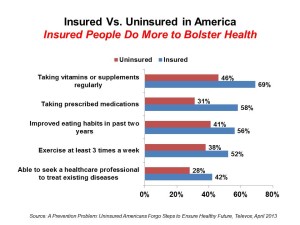
Insured Vs Uninsured do less for healthIf you have health insurance, chances are you take several actions to bolster your health such as take vitamins and supplements (which 2 in 3 American adults do), take medications as prescribed (done by 58% of insured people), and tried to improve your eating habits in the past two years (56%). Most people with insurance also say they exercise at least 3 times a week.
Fewer people who are uninsured undertake these kinds of health behaviors: across-the-board, uninsured people tend toward healthy behaviors less than those with insurance.

This is The Prevention Problem, gleaned from a survey conducted by TeleVox which has published various reports under the company?s Healthy World?initiative. The chart illustrates what TeleVox, a communications support company for health providers, calls out as ?The Ugly Truth? ? that is, the disparity between the health and wellness status of the insured versus the uninsured.

Other key findings from the survey include:

  • Fewer than 1 in 5 uninsured people consider themselves to be extremely healthy
  • People without health insurance are less knowledgeable about preventive care: 33% were uncertain what constitutes prevention, versus 16% of insured people
  • Still, 91% of the uninsured believe that some form of prevention is important, and 81% of the uninsured say that taking preventive care measures can save patients money
  • Nonetheless, 17% of the uninsured who have been given preventive health recommendation gave themselves a grade of ?F? when it came to following this information up.

The consumer survey was conducted among 1,015 Americans age 18 and over in April 2013, along with a poll of over 2,200 health providers.

Health Populi?s Hot Points:? Three-quarters of people die from noncommunicable diseases (NCDs) ? conditions like heart disease, diabetes, various cancers among them ? which are largely amenable to prevention and changing lifestyle behaviors. There are 4 such behaviors that move the needle on chronic disease:

  1. Doing more physical activity
  2. Eating healthy food in healthy proportions
  3. Drinking alcohol moderately
  4. Quitting smoking.

Fewer people who lack health insurance tend to make fewer of these healthy choices.

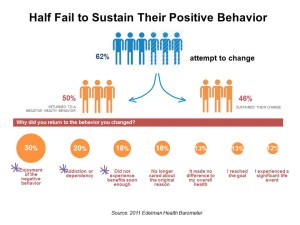
Edelman 2012 Health Barometer Half Fail to Sustain Positive Behavior

It?s not easy to change health behaviors. The Edelman Health Barometer of 2011 found that two-thirds of people try to change a behavior in a past year, and only one-half sustain that change, lapsing back into the original (unhealthy) choice.

As uninsured people in America are invited to access health plans through health insurance exchanges (marketplaces), folks will be exercising new muscles. First, the lack of knowledge of how to shop for health insurance, and how to evaluate different options across different health plans available in the local marketplaces; and second, once enrolled in a health plan, how to use the health system. This new-new milieu means finding a primary care doctor, versus continuing to use the emergency department for an infection or to investigate a lump that went unchecked for many months before attaining insurance coverage.

Learning to be health literate, and health plan literate, will be Job 1 for the newly-insured. TeleVox?s survey shows us there is much education to be done. Setting up a health insurance exchange ? which is heavy lifting in itself ? is but one pillar of getting the uninsured insured. Once insured, there?s new workflow for people to embrace and implement. Health behavior change is hard, and one of those behaviors will be shifting newly-insured consumer mindsets from expensive, inappropriate health care settings (namely, hospital departments) to lower-cost, more appropriate and convenient providers (e.g., primary care, retail health clinics, worksite clinics, school-based clinics, and the like).

That?s the health care utilization piece of the puzzle. The other big opportunity is to promote prevention and healthy behaviors where the newly insured live, work, play and pray ? in their home and communities. That?s where the local food system, schools, workplaces, retail and community organizations play a huge role on a daily basis to help people access local resources to improve on food choices, increase physical activity, and support smoking cessation (very amenable to social networks and competitions).

While costs of serving the newly insured may raise aggregate health care costs in the U.S. in the first years of health reform implementation, in the longer run, the public?s health burden of disease could benefit from getting people into preventive programs sooner?thus, closing the health/wellness gap that is The Ugly Truth of the insured and the uninsured.

Source: http://healthpopuli.com/2013/05/24/the-health-and-wellness-gap-between-insured-and-uninsured-people/

ufc 145 results orrin hatch marlon byrd charles colson humber raffi torres michael mcdonald